
US Car Drifting & Racing Games
Gaming EngineRole Playing
4.26.00 Reviews
- Version
- 0.2
- Installs
- 1.00M
- Age Rating
- Everyone
Screenshots
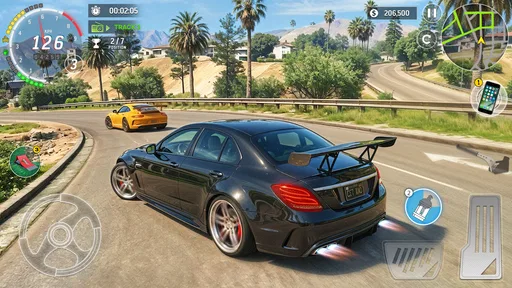
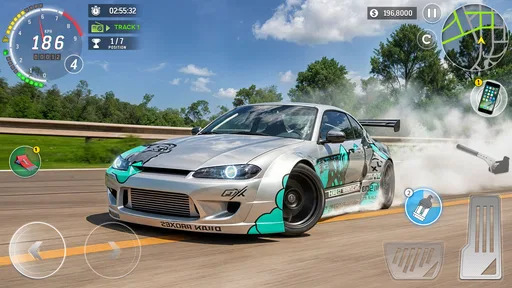
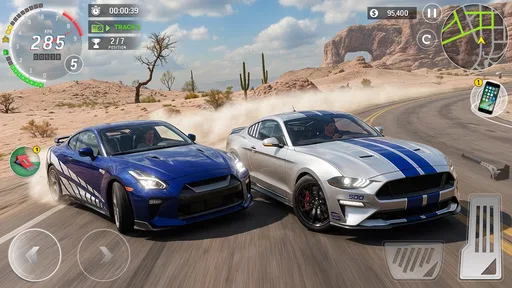
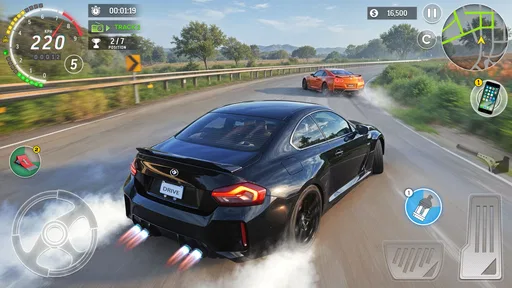
Our Review of US Car Drifting & Racing Games
 Analysis by Appyee
I spent time with US Car Drifting & Racing Games as a lightweight role-playing driving game, and my first impression was clear: it wants the excitement of fast American-car racing without asking the player to learn a complicated setup before getting behind the wheel. The focus is on drifting, speed, and intense driving tracks, so the appeal is immediate rather than story-heavy. I could start thinking about corners and control instead of reading through a long introduction.
That simplicity is both the game’s strongest quality and its main limitation. If you want a quick driving session with an arcade feel, it is easy to understand. If you are looking for a deep career mode, detailed car tuning, or a carefully written role-playing adventure, this is probably not the right destination. I see it as a pick-up-and-play experience built around the sensation of controlling a car through demanding courses.
What the first races ask from you
The early appeal comes from a very familiar goal: stay on the track, carry speed, and make the car behave through bends. Drifting gives the driving a little more personality than a basic point-to-point race, because simply pressing forward is not enough. You have to judge when to turn, how much momentum to keep, and whether a corner is better approached cleanly or with a controlled slide.
I like that this creates an immediate reason to replay a section. A first attempt may be about surviving the route, while the next one becomes an effort to take a corner more smoothly. That kind of self-improvement works well in short sessions, especially when I only have a few minutes and want an activity with a clear objective.
The game’s role-playing classification should not lead you to expect a character-focused journey. Here, the role-playing flavor is better understood through the sense of developing as a driver and working through driving challenges. The central pleasure is still racing, and the car is the real focus of attention.
How progress feels during play
In a driving game like this, progress is not only about reaching the next event. I also look for small signals that my control is improving. A corner that once forced me to slow down can become a place where I maintain speed. A drift that initially feels accidental can become something I start deliberately. Those moments give the game more staying power than the basic premise might suggest.
My practical advice is to avoid treating every turn as a place to use maximum speed. The quickest-looking approach is often the one that sends the car wide. I found it more useful to learn the rhythm of each track: prepare before the bend, make the turn decisively, then accelerate once the car is aligned again. This is a simple habit, but it makes the driving feel more controlled and gives repeated attempts a purpose.
Another useful approach is to separate “finishing” from “driving well.” On an early run, completing the course can be enough. On a later run, I would focus on one troublesome section instead of trying to improve everything at once. That makes the challenge less frustrating and helps reveal whether a mistake comes from entering too quickly, turning too late, or overcorrecting during the slide.
The game does not need an elaborate progress screen to make that kind of improvement meaningful. The road itself becomes the feedback. When the car stops fighting every corner, I can feel the difference immediately. That is a more personal progress signal than simply seeing a larger number on a menu.
The challenge is strongest when speed meets control
The difficulty curve feels tied to handling rather than to a complicated set of rules. Fast tracks are exciting, but speed reduces the time available to correct an error. Drifting adds another layer because a slide can look impressive while quietly carrying the car toward the edge of the course. The challenge is therefore about restraint as much as aggression.
I would recommend learning to finish a route consistently before chasing stylish drifts everywhere. This is especially important for new players who are used to ordinary racing games, where braking and clean cornering may be the safest answer. Here, the temptation to slide can make a familiar turn much harder. Once the basic line feels comfortable, drifting becomes more useful and less like a gamble.
That balance also affects who will enjoy the game. Players who like quick reactions and repeated attempts should find a natural rhythm. Someone who dislikes restarting after a small mistake may become impatient, particularly if they expect a relaxed cruising experience. The title suggests speed, and the driving focus supports that expectation rather than offering a calm open-road simulator.
I would not compare it directly with a realistic racing simulator. A simulator usually rewards precise vehicle knowledge, detailed setup, and authentic driving behavior. This game is better suited to someone who wants immediate action and a more accessible interpretation of car drifting. On the other hand, compared with a very simple endless driving game, the track-focused challenges give each attempt more direction.
Where the pacing works, and where it may lose momentum
The pacing depends heavily on whether the player enjoys repeating driving situations to improve. That is a good foundation for short bursts of play, because I can return for one more attempt without needing to remember a large story or a complicated collection of objectives. The driving itself supplies the reason to continue.
Still, this structure can feel narrow if the player needs constant variety. The store identity centers on US car drifting and racing, so the experience is not pretending to be a broad collection of unrelated activities. I would choose it for a focused driving mood, not for a game that continually changes its rules or genre.
There is also a difference between meaningful challenge and pressure to keep playing. A difficult corner can encourage me to refine my technique, but repeated failure without a clear sense of improvement can have the opposite effect. My suggestion is to play in small sessions and stop after a few unfocused attempts. Returning later with a fresh hand often works better than forcing progress while frustrated.
In-app purchases range from $0.49 to $9.99 per item, so the free entry point is useful for deciding whether the driving feels right before spending anything. I would keep purchases separate from the core decision to enjoy the game: first test the controls, the tracks, and the replay value. If those basics do not hold your attention, an optional purchase is unlikely to solve that problem.
Controls, attention, and everyday use
This is the kind of game I could imagine opening during a break, while waiting for an appointment, or at the end of the day when I want something more active than scrolling. A realistic session might be this: I have ten minutes, start a route, lose control on a fast bend, then try again with a slower entry and a wider exit. Even if I do not complete a long play session, I have a concrete driving problem to work on.
That short-session value is helped by the clear theme. I do not need to prepare a team, manage a large inventory, or remember a complicated plot. I can concentrate on the track. The trade-off is that the game may not offer enough depth for someone who wants a long-term management layer around the racing.
When playing, I would keep my attention on the approach to the corner rather than the drift itself. The slide is only useful if the car exits in a position that allows the next section to flow. This is one of the less obvious lessons in the game: a dramatic-looking maneuver is not automatically a successful one. Clean exits matter more than showy entrances.
I also recommend avoiding constant corrections. Oversteering from one direction to the other can make the car feel more unpredictable, especially at high speed. A calmer input, made earlier, usually gives more room to recover. That tip is not a shortcut to winning, but it makes the game’s challenge feel fairer and helps turn mistakes into information.
Who should try it and who should look elsewhere
I think this game is a good match for players who want fast arcade-style driving, enjoy drifting as a central mechanic, and prefer goals they can understand immediately. It is also approachable for someone who does not want to commit to a large role-playing game. The Everyone content rating makes it suitable for a broad audience, although younger players should still have an adult handle any purchase decisions.
The game is less suitable for players who want realistic motorsport rules, extensive vehicle customization, or a narrative campaign with memorable characters. A dedicated simulation racer will be a better choice for authentic handling and technical detail. A deeper role-playing game will be better if your main motivation is equipment management, dialogue, exploration, or a long character arc.
I would also hesitate to recommend it to someone who wants a completely passive experience. The appeal comes from responding to the track. You need to pay attention, especially when speed makes a mistake expensive. That involvement is rewarding when I am in the mood for it, but it is not ideal when I only want to watch progress happen automatically.
What the numbers suggest about its place
The game has a 4.2 average from around 878 ratings and has passed one million installs, which suggests that its straightforward driving idea has reached a substantial audience. I would treat that popularity as a reason to investigate, not as proof that it will suit every player. Driving preferences are personal, and the value here depends on whether drifting and repeated track attempts keep you interested.
It is free to start, developed by Gaming Engine, and currently listed at version 0.2. The version number makes me view it as an experience that may still feel early in its life. That is not automatically a negative, but it does shape my expectations: I would judge it mainly on the quality of the driving loop rather than expecting the breadth of a long-established racing series.
The minimum operating-system requirement is Android 7.1, which makes the game accessible to many older Android devices. Even so, I would not assume that every phone will feel identical during fast driving. On a smaller or older device, visual clarity and input comfort can matter more than raw feature count. If the screen feels cramped, concentrate on learning the route instead of making rapid, unnecessary corrections.
My verdict on the progression loop
US Car Drifting & Racing Games works best when progression means becoming more confident behind the wheel. Its early goals are easy to grasp, its strongest progress signals come from better control, and its challenge grows through the tension between speed and precision. That creates a compact loop: attempt the track, identify the mistake, adjust the approach, and try again.
The loop is not designed for every kind of player. It may feel too focused for anyone expecting a large role-playing world, and the replay value depends on enjoying improvement rather than needing constant new systems. I also think the free-to-start model deserves a measured approach: test the foundation first, then decide whether an optional purchase adds value for the way you play.
My final recommendation is positive but specific. I would suggest it to a friend who wants an accessible drifting game for short, energetic sessions and who enjoys turning failed corners into better attempts. I would point a simulation fan or a story-driven role-playing player elsewhere. For the right audience, the uncomplicated design is an advantage: the game gets quickly to the road, gives speed a clear purpose, and lets driving skill—not a pile of menus—decide whether the next run feels better than the last.
Verdict
Strengths of US Car Drifting & Racing Games
- Responsive drifting controls make cornering feel smooth and satisfying.
- A wide selection of American cars adds variety to each race.
- Short events are convenient for quick gaming sessions.
- Visual effects make crashes and tire slides feel exciting.
- Offline play is useful when you have no internet connection.
Limitations of US Car Drifting & Racing Games
- Some vehicles and upgrades require considerable in-game grinding.
- Repeated tracks can make the experience feel predictable over time.
- Drifting physics may feel exaggerated to realistic racing fans.
- Ad interruptions can reduce the pace between races.
- Performance may drop on older phones with limited hardware.
Similar Picks in This Category
View All
Hair Dye
CrazyLabs LTD4.4

Monster High™ Beauty Salon
CrazyLabs LTD4.5

Bus Simulator - Bus Games 3D
Jima Apps4.4

Flight Pilot: 3D Simulator
Wildlife Studios4.1


Super Stylist Fashion Makeover
CrazyLabs LTD4.4
Frequently Asked Questions
What is US Car Drifting & Racing Games?
US Car Drifting & Racing Games is a mobile driving game focused on American-style cars, street racing, and drift challenges. After trying its events and free-drive areas, I found that it combines arcade handling with customization and competitive races. It is designed more for quick, action-packed sessions than for a realistic driving simulation, making it accessible to casual players.
Can I play US Car Drifting & Racing Games offline?
Some parts of US Car Drifting & Racing Games may be available without a constant internet connection, particularly basic driving or single-player activities. However, online features, advertisements, cloud progress, leaderboards, updates, and certain rewards may require internet access. I recommend launching the game online at least once and checking the in-game requirements before relying on it during travel or in areas with limited connectivity.
Does the game include car customization and upgrades?
Yes, customization is one of the main attractions of US Car Drifting & Racing Games. Depending on the version installed, players can usually change the appearance of their vehicles and improve performance through upgrades. These options may include paint, wheels, visual details, engine improvements, handling, and acceleration. Progression can require in-game currency, so unlocking every option may take time or optional purchases.
Is US Car Drifting & Racing Games suitable for beginners?
The game is generally approachable for beginners because its controls are built around straightforward touchscreen inputs rather than complicated simulation settings. New players can learn the basics of steering, acceleration, braking, and drifting fairly quickly. That said, precise drifting and later races require practice, especially when opponents become faster or tracks demand sharper turns and better control.
Are there ads or in-app purchases in US Car Drifting & Racing Games?
Players should expect that US Car Drifting & Racing Games may contain advertising and optional in-app purchases, as is common with free mobile racing titles. Ads can appear between races or when claiming bonus rewards, while purchases may provide currency, vehicles, upgrades, or other advantages. Before downloading, review the store listing and device purchase settings if you want to control spending.
Play our best games!


